 Download app
Description
A Gift for People with Fear of Honeybees is ten gentle gardens that bring people who are afraid of honeybees closer to them, one step at a time. It starts in a meadow with no bees, then one bee far away, then forty bees working the lavender, then a bee who lands near you only when you invite her. You choose when to go on, and you can step back at any time.
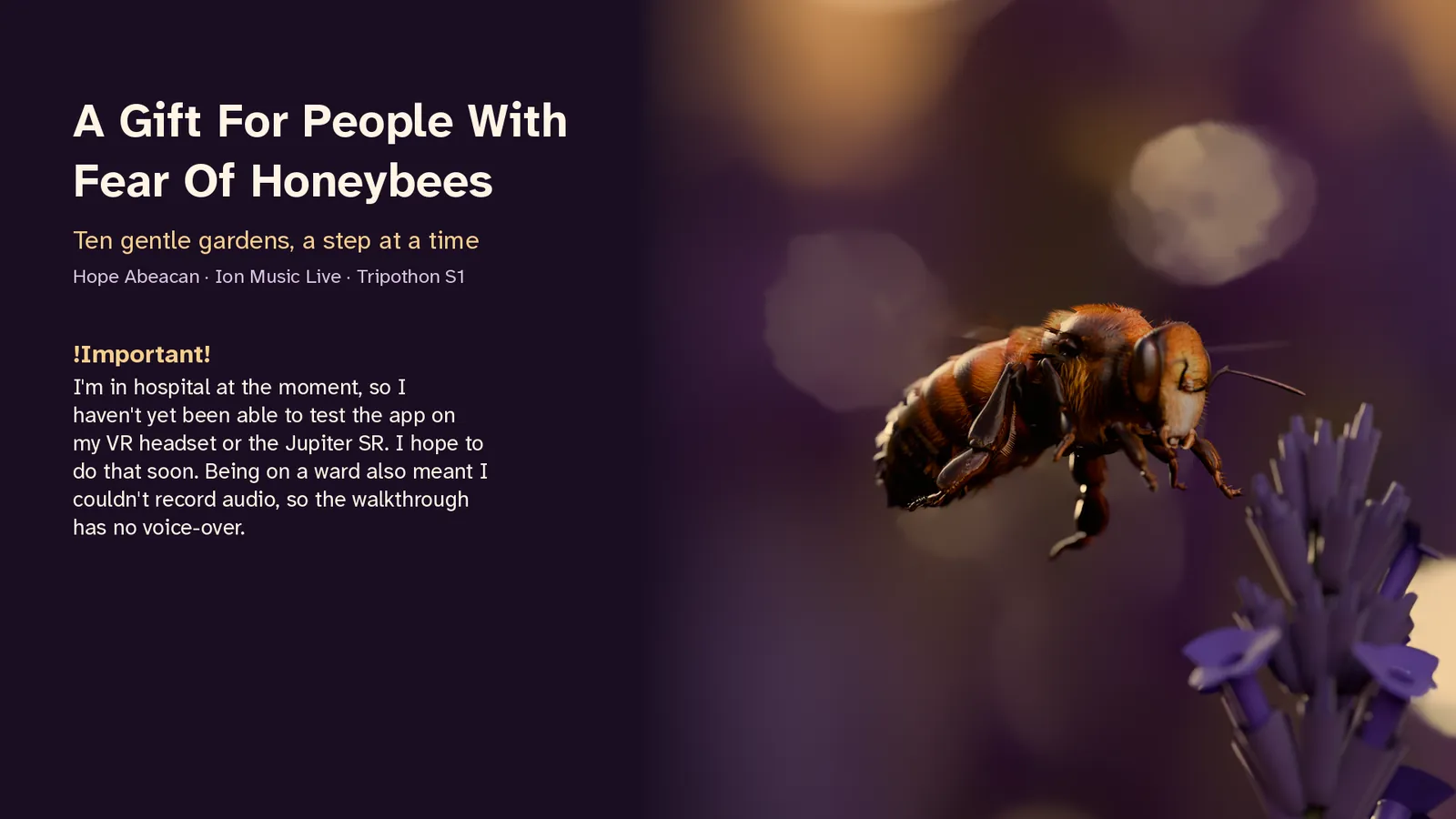
Tap any plant to see its 3D model and its blooms; later on, see it the way a honeybee does. The honeybee itself was made in Blender with idle, hover, takeoff, landing and forward-flight animations, because how a bee moves matters most to someone who fears her.
The gardens run on a desktop and in a headset, and side by side for the Jupiter SR 3D display. A screen you sit in front of can be an easier first step than a headset: two sliders set how deep the garden feels and which distance sits on the glass, so a guide can bring a bee nearer without moving her, and in the full garden a fingertip on the glass invites a bee to land. This mode was built and checked side by side and has not yet been tuned on the screen itself.
The author wrote a Marble prompt for each garden, and the Gaussian splats were generated in code from those prompts and rendered with World Labs' Spark; choose a bee's view and the whole garden shifts into bee colors. In the Lite edition the splats sit on solid ground, paths and walls so you can walk them, and any garden can also open a Marble export directly. The project is built on Three.js, with Claude, ComfyUI and TRELLIS also used along the way; content sources and research are credited in the app. About 10 of the Tripo assets existed before the hackathon.
How Tripo was used
Every plant you can tap in the gardens comes from Tripo.
- Plants and objects: every clickable plant and tree in the ten gardens, and most of the garden objects, is a Tripo model made from the author's own photographs and generated images. Most carry 4096-pixel PBR maps; the rest use 2048.
- Plant info pane: each plant's pane shows the full Tripo model turning slowly beside its bloom images and, in later gardens, the same model through a honeybee's eyes.