 Try it live
Description
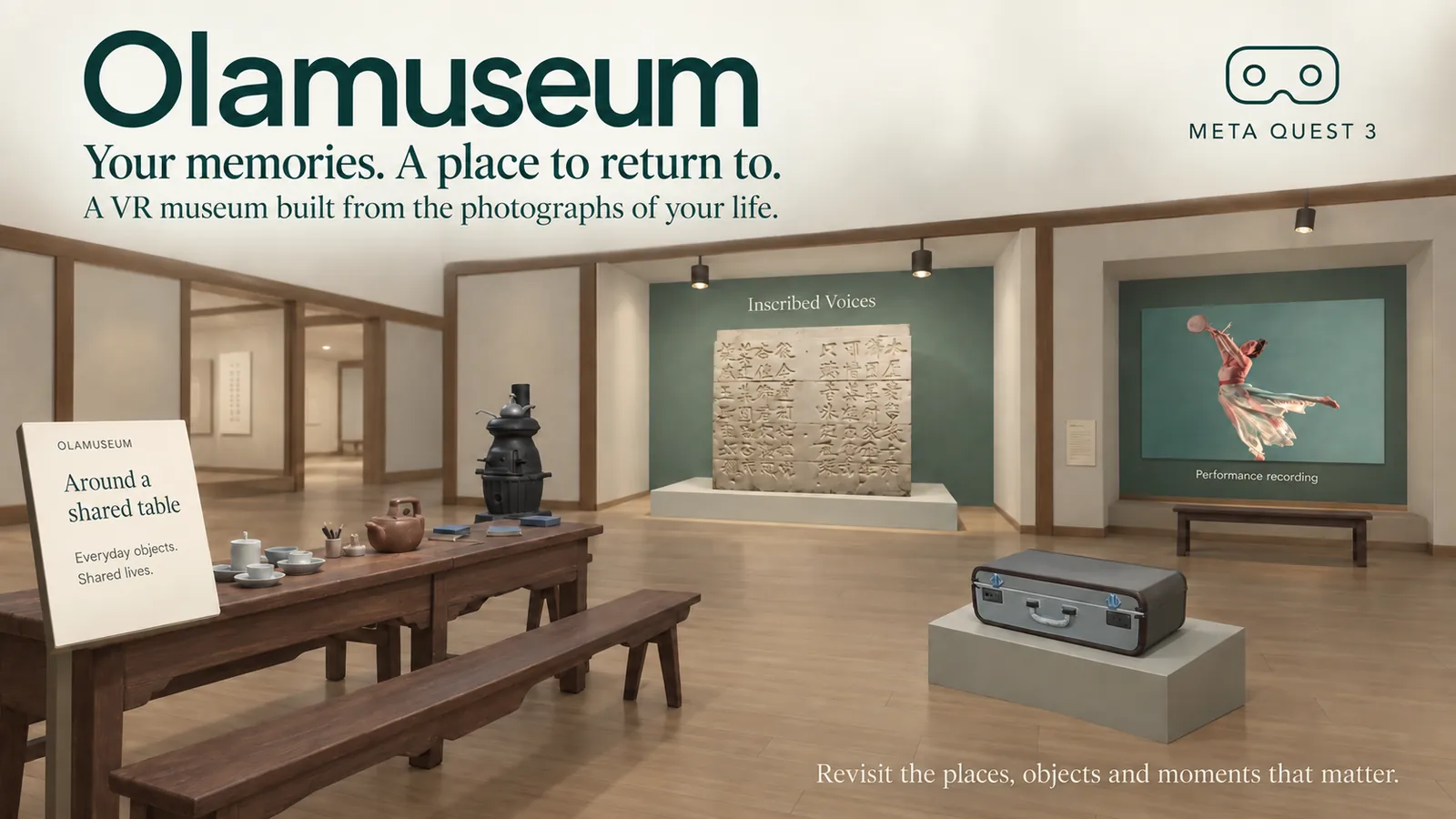
Olamuseum is a museum where history and the present inhabit the same space. Inspired by Angel Island Immigration Station, it brings together historical photographs, poems carved by detained immigrants, and a contemporary dance performance the author gave there in 2023. Accessible on the web and on Meta Quest 3, it invites visitors to encounter these stories beyond the limits of time and place.
The journey unfolds through four connected spaces: arrival, confinement, inscribed voices and living memory. Visitors can wander, approach objects, discover the words behind them, and pause to watch the performance. Light, sound and architectural details create a quiet, intimate atmosphere, somewhere between walking through a museum, entering a memory and becoming an audience member again.
This world is a gift to immigrant communities and their descendants, to people who carry more than one place within them, and to anyone unable to visit Angel Island in person. It offers a space for remembrance without prescribing how visitors should feel. At its heart is a simple belief: the past is not separate from us. It lives in our bodies, our movements and the stories we choose to carry forward, and Olamuseum uses VR to make room for those stories and for the people who will encounter them next.
Olamuseum is an ongoing project rather than one built entirely from scratch during the hackathon: a web museum prototype dates from August 2026 and a Unity and Meta Quest 3 prototype from early October 2026. Tripo generation and collection integration were done on October 4–5, followed by more exhibit interactions, documentary displays and presentation work on October 6–7. The materials include Angel Island photographs, photographed museum displays, poetry translations, existing 3D models, and a performance recording with its soundtrack; World Labs Marble was also used for an optional web-based spatial study.
How Tripo was used
Tripo is Olamuseum's core photo-to-3D engine.
- Image-to-3D: the team used the Tripo API to turn museum photographs into textured objects, then cleaned the geometry, corrected scale and optimized the GLBs for Three.js and for Unity on Meta Quest 3.
- In memory spaces: rather than displaying isolated AI models, they placed them in explorable memory spaces alongside stories and performance recordings.
- The workflow turns photographs into spatial experiences while keeping inferred geometry distinct from documented history.