 Try it live
Description
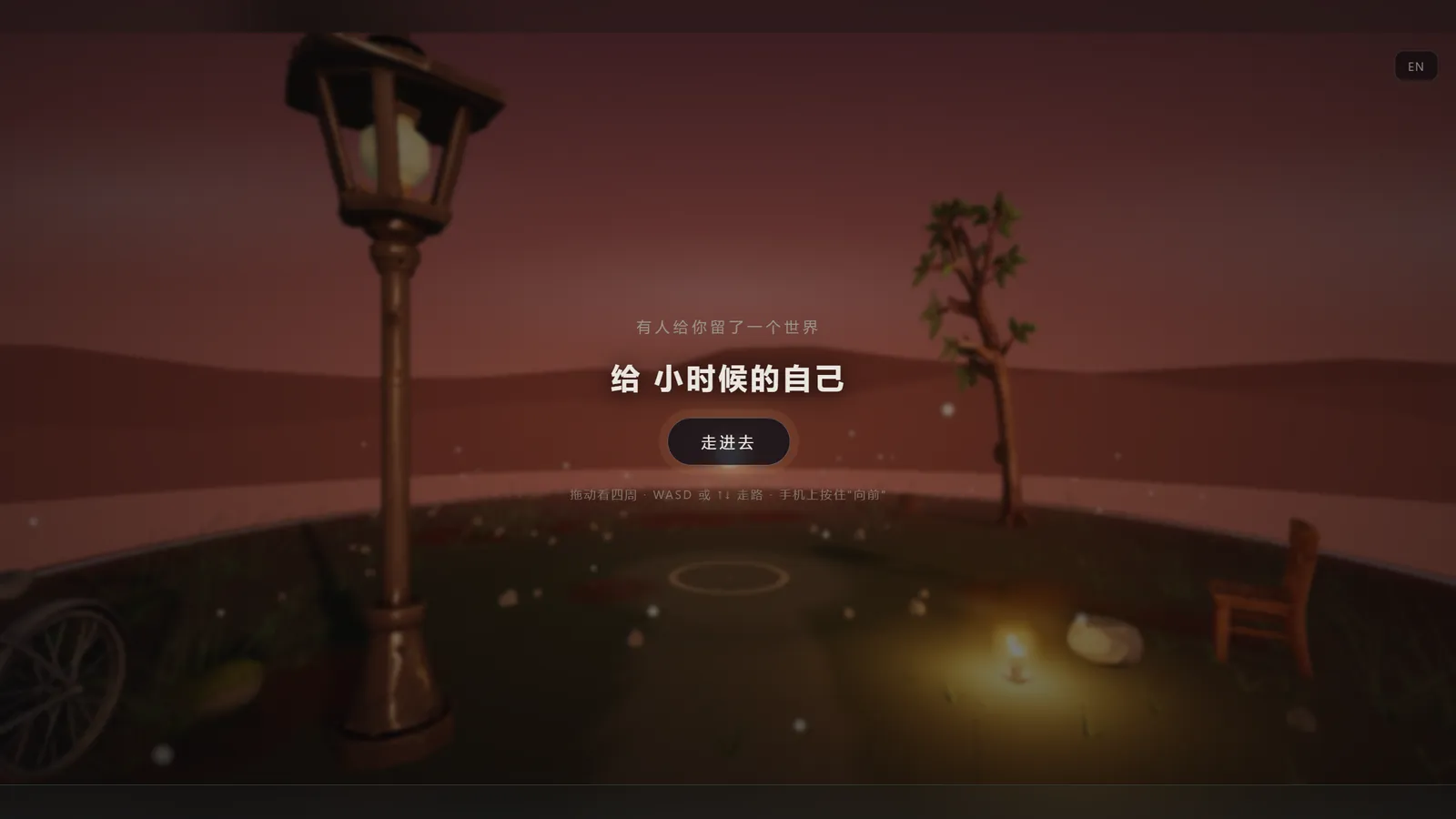
Postcard World isn't a world; it's a machine for giving worlds away. Write down who it's for and one thing that happened between you, and it builds a miniature world that belongs only to that person: 6.5 meters wide, just big enough to hold one thing and one person. You get a link and send it. They open it and walk in, and only when they reach the middle does the sentence you wrote surface.
The recipient can also pick one thing, a paper boat, a candle or the letter, and write back; that reply is just another link. So this is a two-way exchange, not a static showcase page. Objects are placed at real-world sizes (a 0.12 m letter, a 0.9 m chair, a 3.5 m streetlight, a 4.5 m tree) against a 1.62 m eye height, which gives the little world a believable sense of space. They are more than set dressing, too: they carry mechanics, brightening a notch as you approach and drifting toward the center when a reply is written.
There is no backend at all. The entire world is encoded in the link, 282 characters for the sample world, with no server and no database, and the link never expires. The piece loads no image, font or audio files: grass, ground, sky, distant mountains, clouds, stars, rain, snow and puddles are all generated in code, the soundscape is synthesized live with Web Audio, and the interface uses system fonts. There is no build tool either; it runs on the browser's native ES modules and import maps. Apart from the 3D assets, no images, audio or text were AI-generated, and the code was written by the author.
How Tripo was used
All 14 3D assets in the scene were generated with Tripo's text_to_model (text-to-3D) API, with zero placeholders. Without Tripo, the author says, the piece would have been reduced to arrangements of basic geometry.
- Specs: each asset is a GLB with a 512×512 base color map and a normal map, at about 11.5k triangles. A generation script calls the Tripo API, and the output goes through scripted import and compression before three.js loads it directly at runtime.
- Three narrative roles: things that respond to you (the lamp, the candle), things that give scale (the bicycle, the tree, the clock) and things you lean down to read (the letter, the paper boat). The form and material of the assets decide whether this feels like a place at all.
- Objects as mechanics: they are moving parts of the machine, not just models to look at, brightening a notch as you approach and drifting toward the center when a reply is written.