Description
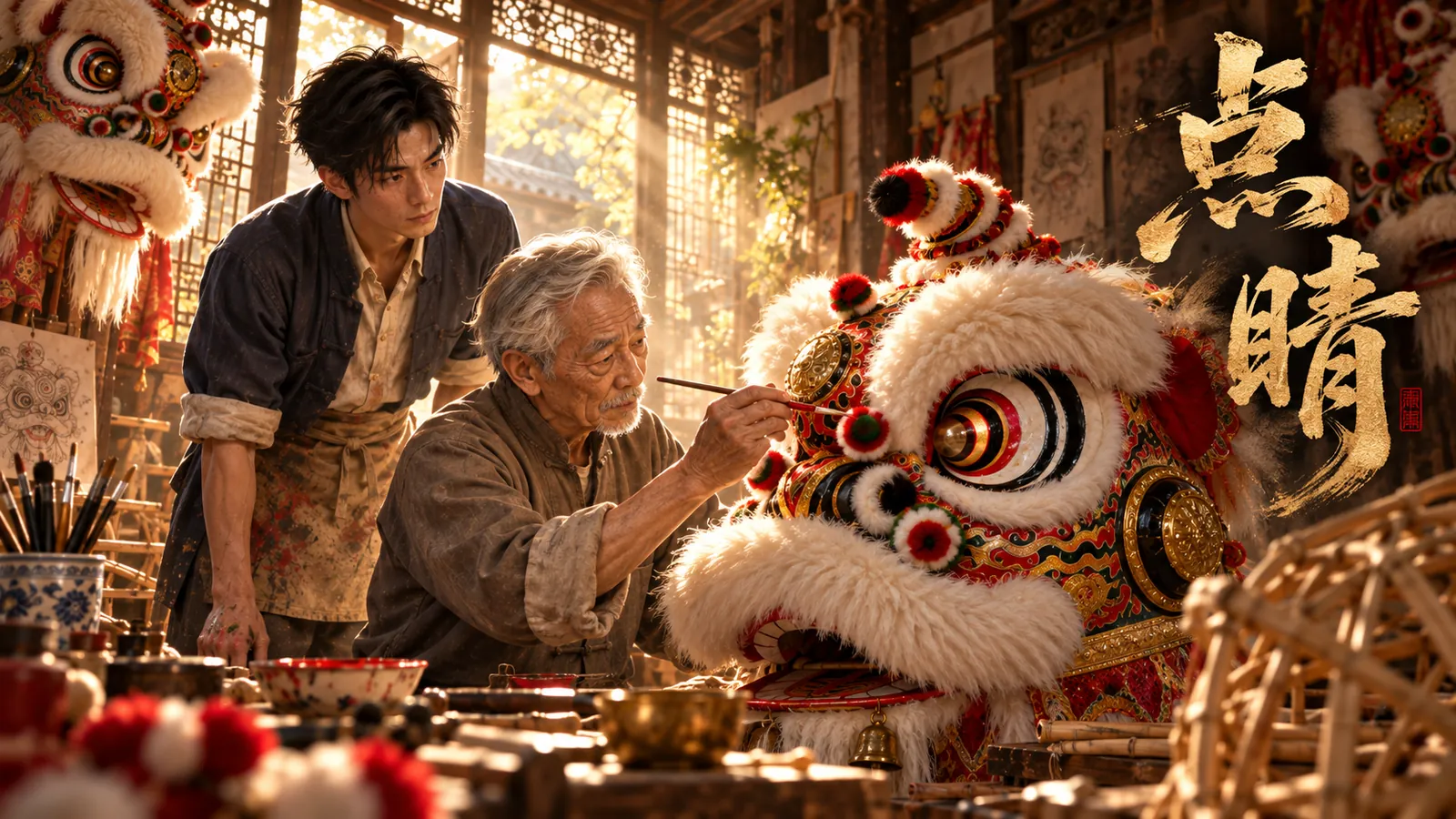
Dotting the Eyes is built around xingshi, the "awakening lion" dance of Guangdong's Lingnan region, and the traditional craft of making the lions, telling a story of one generation of craftsmen passing their art to the next. In a lion-making shop on an old Lingnan street, a young craftsman keeps reworking his lion. The bamboo frame, rice paper, fur and painted details are all finely made, yet no matter what he changes, he feels the lion still lacks a true spirit.
An old master passes by the shop. He does not tear down the young man's work or start over; he only adjusts the brows, the corners of the eyes and the fur by a few millimeters, and with a handful of strokes reshapes the lion's expression. Finally, he picks up a brush dipped in cinnabar and performs the traditional eye-dotting. There is no showy magic and no explosion when the brush touches down: morning light enters the lion's eyes, its white fur stirs in a light breeze, the brass bells sway faintly, and what was only a handicraft seems, for the first time, to see the world. It goes from still, to alive with spirit, to truly awake.
Through this story, the author wants to say that real inheritance is not copying what the previous generation made, but understanding why a craft can come alive. The final stroke is the old master's gift to the young craftsman, and tradition's gift to the future, for the next generation still willing to carry tradition on. One stroke dots the eyes, and what wakes is not just the lion but the craft, and the passing-on of it.
The film uses a cinematic photoreal style, set mainly in a traditional Lingnan lion-making shop, with close-up material detail such as bamboo fibers, an old wooden table, cinnabar, brushes, lion fur and hand painting to make the craft feel real enough to touch. AIGC was used mainly for the characters, scenes, continuous shots and moments that are hard to film in reality, such as the lion awakening. The author deliberately held back on AI effects: the first half stays strictly realistic, and only after the eye-dotting do restrained surreal changes appear, so that the technology does not replace tradition but helps the abstract spirit, vitality and charm of traditional culture take visible form. Dotting the Eyes was created from scratch for this competition.
How Tripo was used
Tripo handled the 3D groundwork for Dotting the Eyes, turning the visual designs of the lion and the workshop into 3D references that kept the AIGC storyboards consistent.
- 3D reference assets: the designs for the Lingnan lion, the traditional workshop and more were turned into 3D reference assets with Tripo for later production, then used to check and adjust form, structure and spatial relationships.
- Consistent storyboards: the models gave the author a quick grasp of the lion's three-dimensional structure, so the lion head's proportions, silhouette and spatial relationships stayed consistent when the storyboards were generated with AIGC. Image generation, video generation and editing tools then completed the film.