Author: kevin
 Try it live
About this project
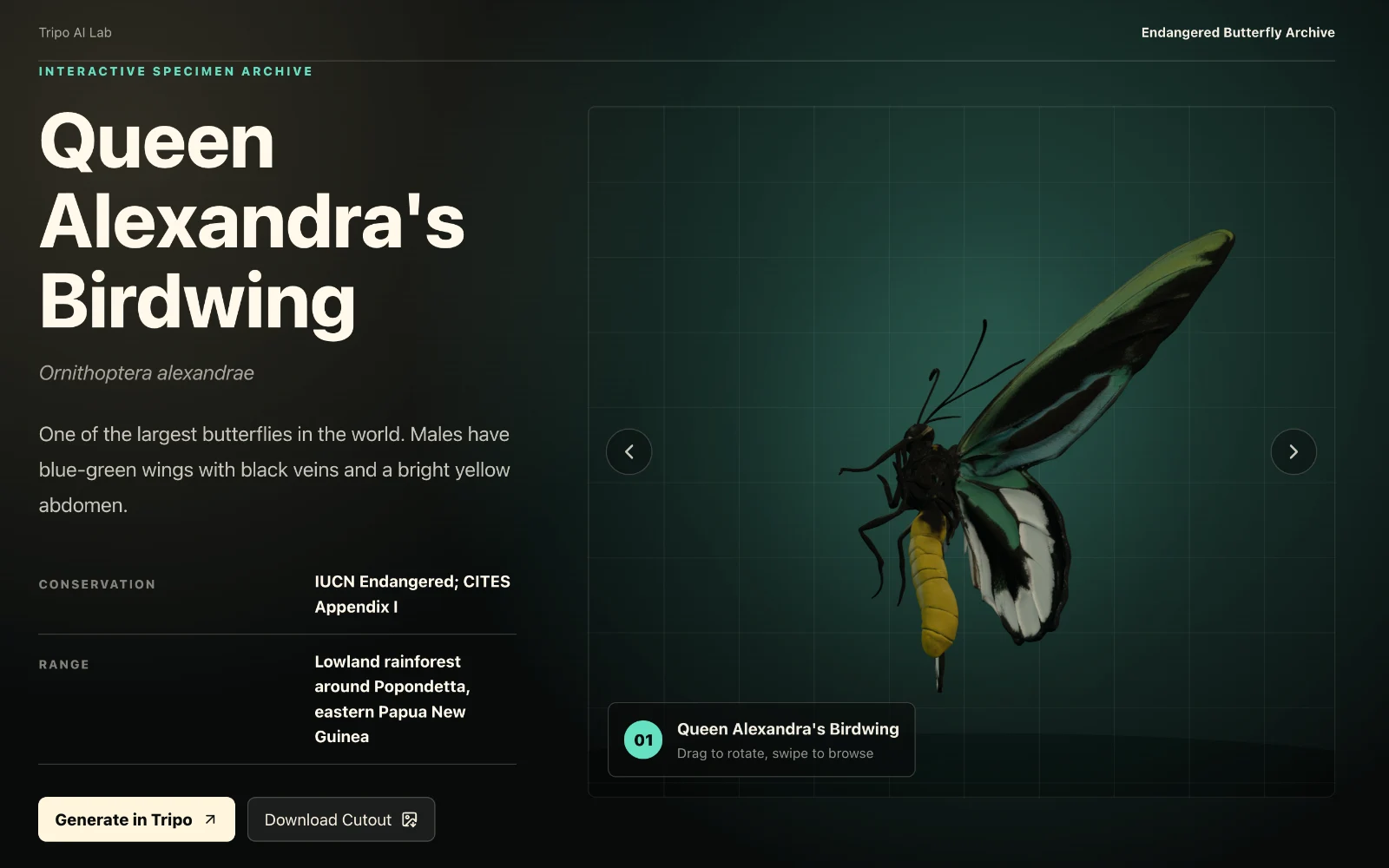
The archive covers six endangered butterflies, from Queen Alexandra’s Birdwing to the Homerus Swallowtail: each gets a drag-to-rotate 3D specimen alongside plain-language notes on conservation status (IUCN / CITES), range, habitat and key threats, searchable and filterable by protection level.
The site plugs straight into the Tripo API: every species ships with a tuned modeling prompt you can copy in one click — or fire off a text-to-3D task on the spot and poll it to completion. Reference images and model files are downloadable too, turning "view a specimen" into "make one".
Highlights
- Six endangered butterflies as drag-to-rotate specimens — read the wing detail from any angle
- Search and filter species by name or conservation status (IUCN / CITES)
- Every species ships with a tuned modeling prompt, copyable in one click
- Wired straight into the Tripo API: fire off a text-to-3D task on the spot, poll it to completion, and download references and models
Technical breakdown
Tripo API · the text-to-3D task pipeline
The whole Tripo integration sits in one standalone service file, and the flow takes just three steps: authenticate with a Bearer key; create a text-to-3D task with the species prompt (texture and pbr switched on, texture quality set to standard); then check the task every 4 seconds — once generation finishes you get a direct download link for the model, and failures, cancellations and timeouts are all handled gracefully.
Those few dozen lines make a ready-to-use integration template: authenticate, create the task, poll, fetch the result. Copy them into your own project, swap in your API key, and they run.
Prompt engineering · one recipe per species
Each of the six species carries a modeling prompt tuned over many rounds, and the recipe splits into three parts: describe the form clearly (male dorsal view, vein layout, abdomen coloring), rule out what you don’t want (matte, please — no metallic sheen, no iridescence), then state the delivery requirements (thin wings, clean topology, PBR textures). Every prompt copies in one click — the prompts are the real “source code” this archive wants you to take home.
Specimen viewer · procedural forms + multi-format delivery
The butterflies you drag around on the page are lightweight forms built procedurally in Three.js (a pair of wings, standard materials, a hemisphere light) — they run without a single external asset. Want something finer? Every species also comes with Tripo-generated PBR FBX and base OBJ files to download, and the preview images are Tripo’s own renders — the live interaction and the downloadable assets never get in each other’s way.
The archive · data-driven React
Everything in the species records — conservation status (IUCN / CITES), range, habitat, threats — is rendered from data, and search and filtering happen right in the browser, no backend required. The stack is simply React 19 plus Vite 8, building to plain static files: put them on any static host and you’re live.