 Try it live
Description
In Hermann Hesse's novel The Glass Bead Game, scholars play a game that joins music, mathematics and every field of learning, but the book never gives its rules. This game is one interpretation, made for readers of the novel who wished they could play it.
Glass beads roll in over the rim of a painted board and run downhill toward its drain. Between waves you spend shards to place mechanisms such as springs and walls. A spring kicks a bead in the direction you aim and costs a few shards; contacts with walls and other beads earn shards back. Every interaction makes a sound at its own frequency, and together they make the music. The park stays alive as long as the beads keep moving; when the board falls silent for too long, the stage ends. You score by keeping the board circulating and the beads sounding.
Three levels walk through three places from the novel:
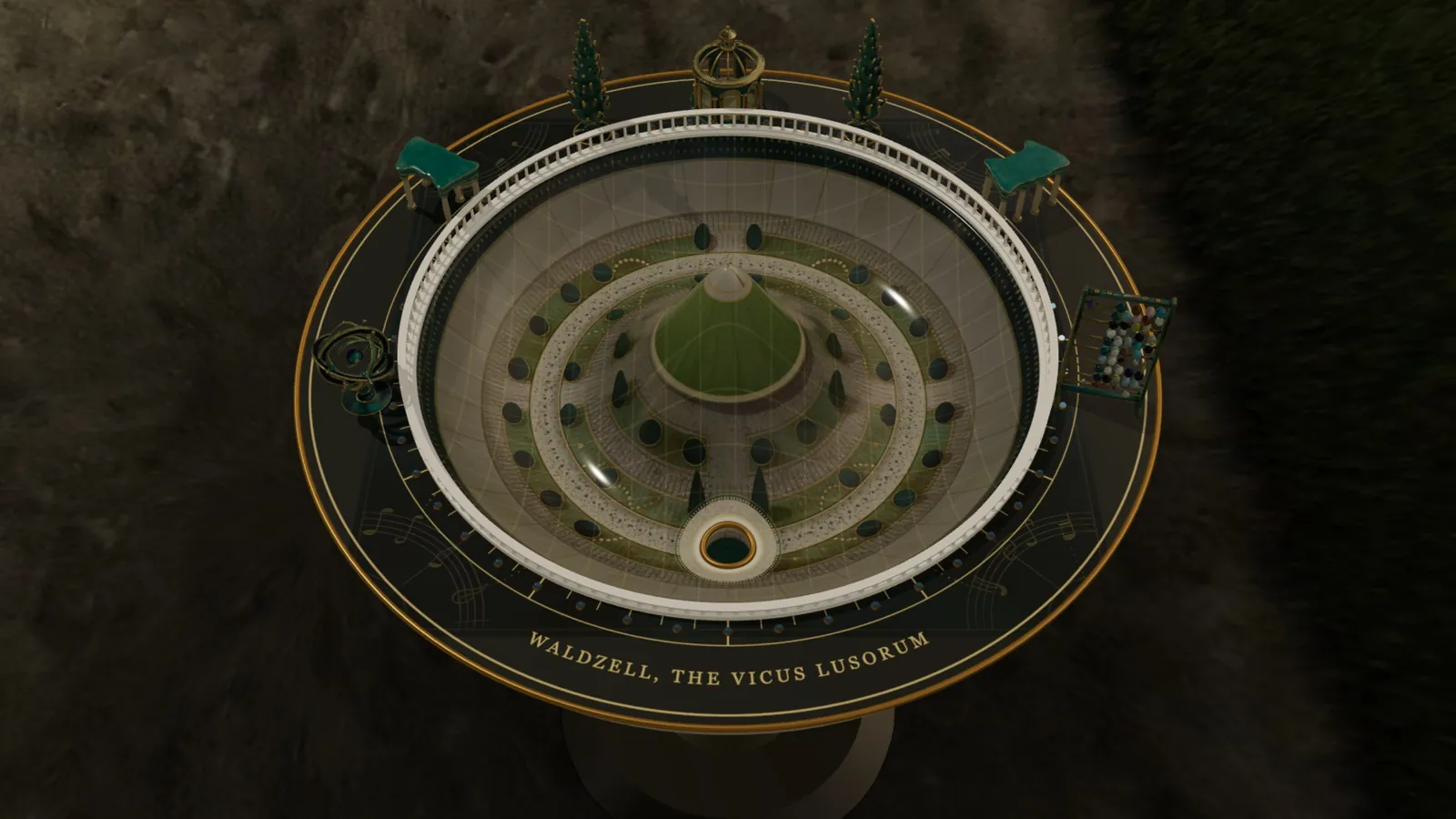
- Ring, at Waldzell: a circular walk around a raised lawn. Learn the spring and make the same bead come back.
- Tilt, at Belpunt: a mountain meadow sloping down to a lake. Add walls and let contacts pay for your springs.
- Oval, at Monteport, the Music Master's house: a track drawn as a musical stave, with a separate exit, where heavy lead beads (Saturn) join the glass.
The author plans to add more levels to the live demo.
Each board is painted to follow its own topology. The gravel walk, the contour lines and the stave are drawn from the same height function the physics uses, so what you see is where beads naturally roll. Each table stands inside a World Labs world of its place, and on the rim stand Tripo props you can click, each answering with a motion and a note; when the last wave passes, the scene fades to the place's evening panorama and the camera lowers for the parting. The game's website also holds an Archive of the 17 bead subjects studied for the game: the seven planetary metals, Earth's glass, five beads named in the novel and four alchemical stages, each growing from a sign to its full form. For lack of time the levels use only glass and lead for now, leaving the rest for future mechanics.
Before the event there was only an idea draft and a browser graybox of an earlier zero-gravity version. Everything in the current game was made during Tripothon: the Three.js bead physics, the three levels, every 3D and visual asset, the sound engine and the website.
How Tripo was used
Tripo P1 made the physical world on and around the board.
- Scale: 183 text-to-3D generations across 13 places from the novel, for the props on each board's rim and a set of mechanism studies.
- Fitting the painting: props were regenerated without bases and in each place's palette, so they sit in the painted board rather than on top of it.
- Interactive: in play, every placed prop answers a click with a motion and a note.
- Bead interiors: the original lead, copper, silver and iron bead interiors began as Tripo models and were refined in Blender.