 Try it live
Description
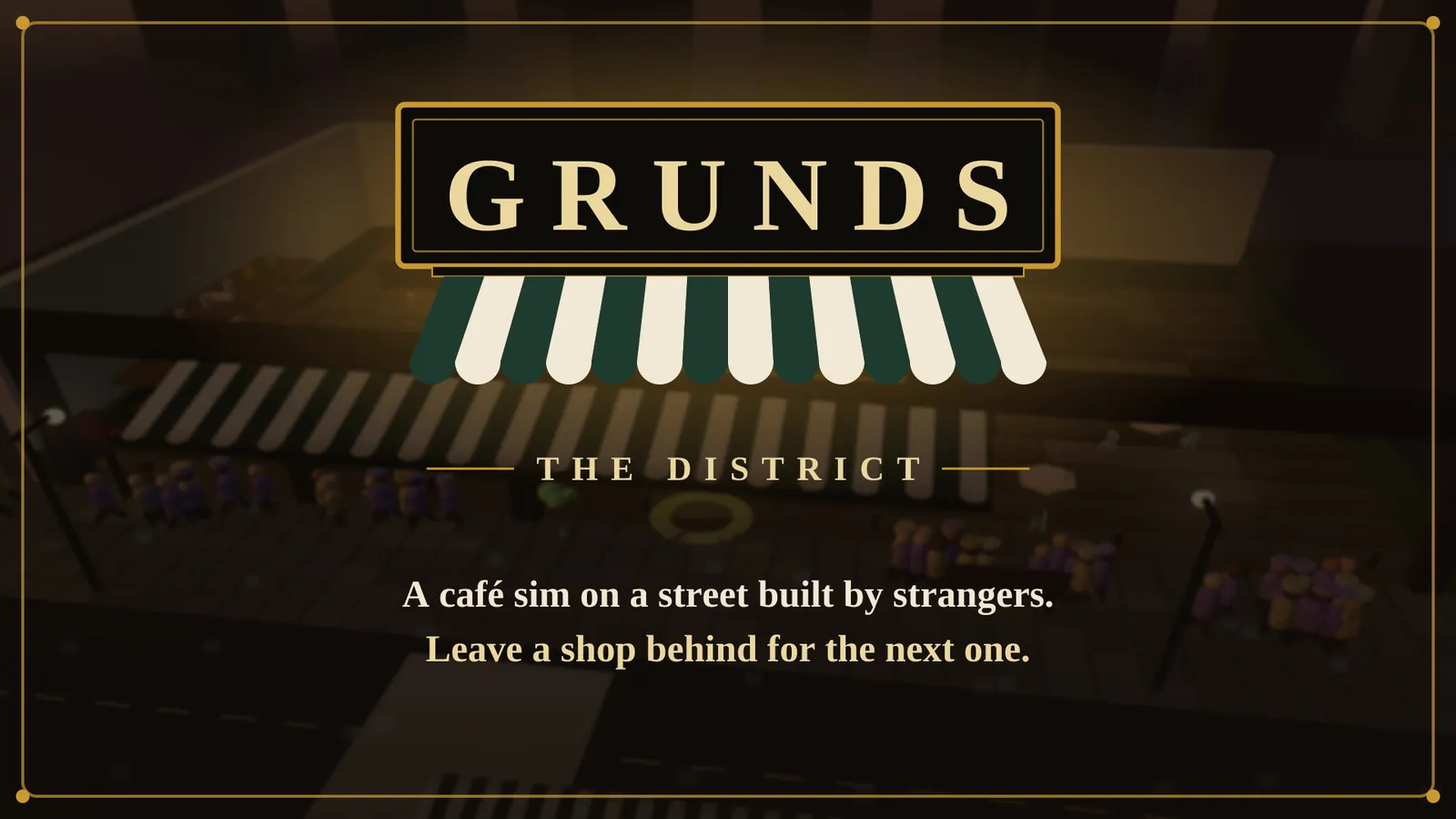
Those before planted the trees; those after rest in the shade. Grunds — The District is a café-management sim set on a street built by the players who came before you. Every storefront, cart, lantern and fountain started as a sentence someone typed, and the game turned it into a 3D shop that is still standing when you arrive. Each district is made and shared by everyone who lands on it.
You run a licensed café stand for one in-game week: price the menu, stock the pastry case, read the morning wire for commodity shocks, and hold your nerve against the rival across the street. Dawn brings a chalked receipt and a letter from your roaster. It plays like a slow, warm morning, with steam, till drawers and a cat on the counter.
The gift is for the stranger who walks this street after you, and it is called The Row: three vacant lots any player can claim by describing a storefront in words, or by sharing a photo link that becomes a shop through image-to-3D. The first claim is permanent and signed. You will never meet the people who come after you, but they inherit what you leave: the ramen counter, the jazz shop, the bakery still standing, paying rent and drawing foot traffic into the new player's economy. The Streets gallery is the deeds office, with every street and every stand signed by its builder and one click away.
Many hands gathering firewood make a tall flame. The streets never reset for the next player; they carry the last one forward, and the more people touch a district, the richer it gets. Grunds began at Convex's "All Gas" hackathon and has been live since September 12. The café simulation, the Three.js diorama, the backend, the campaign loop, the roaster letters and the rival system predate Tripothon; new for this event is the whole generative district, including the Tripo text-to-3D and image-to-3D pipeline, asset persistence, provider fallback, The Row, the purpose-driven economy and the Streets gallery. It is built with Three.js, with Convex for the backend and storage and Vercel as the proxy and hosting layer. All audio is synthesized live with Web Audio, and Mint, the fallback 3D provider, also grew several districts.
How Tripo was used
Tripo is load-bearing, not decoration: every storefront on the street and every claim on The Row is a persisted Tripo text-to-3D or image-to-3D generation.
- District storefronts: each district seed generates six storefronts with Tripo P1 text-to-3D, using deterministic model and texture seeds, face budgets and a shared negative prompt.
- Generated once, shared by all: assets are content-addressed in Convex, so each world is built once and shared by every player.
- Row storefronts: players can author storefronts on The Row from text, or from a photo link through image-to-3D, creating signed, permanent stands the world inherits.
- Scale: about 60 assets across 10 seeds power the economy.