 Try it live
Description
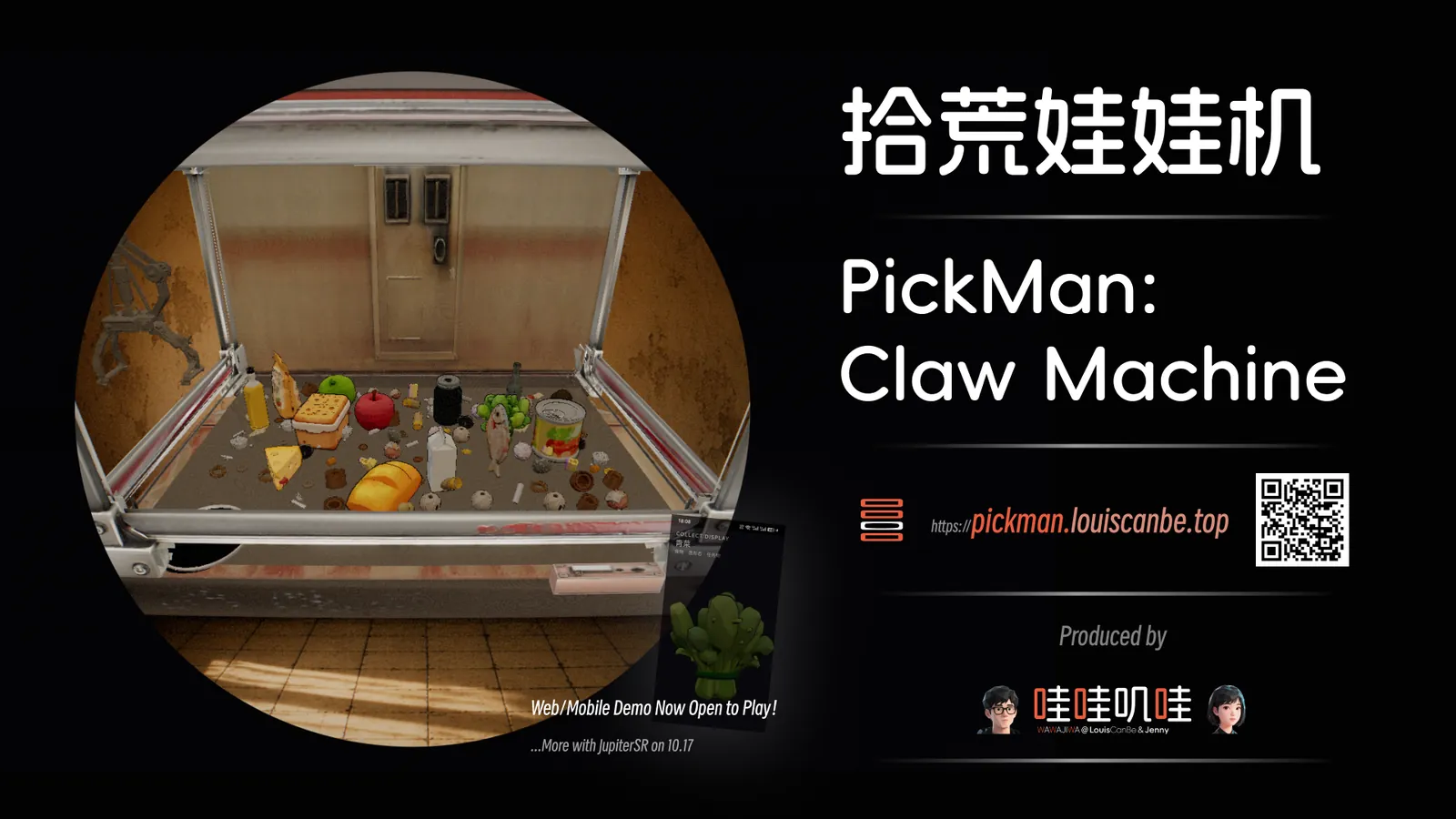
PickMan: Claw Machine is a short playable world. When rationing stopped, people in the streets started calling rummaging through garbage "gathering." The protagonist remembers those days as a claw machine: food stacked neatly behind glass, warm lights overhead, a three-pronged claw hanging in midair. The first four acts take place inside this repaired memory, framed like an old square photo with a slight fisheye at the edges, as if pressed against someone's eye. In the story he shares the meal with a younger sister. She has no face and never speaks; she appears only in a Polaroid and on the empty bed in the final act.
There are only three things to do: look left and right, move the claw, and drop it, with no take-backs. At first you can only look, from the left, the front and the right, at bread, cans, greens and other things in the case. Then you learn to grab. The claw has a slight mechanical lag, and the first grab always works: the bread drops into the chute and he remembers sharing it with his sister. Next comes a handwritten ration list: one bread, one can, one vegetable. The lights dim, the glass grows dirty and the claw starts to slip, more and more like real life, where your grip gives out. Grab the wrong thing and he doesn't correct himself; he only says that one is edible too. The moment all three are in, the bulbs flare, the whole case looks fresh again, and the three items become the meal he remembers. They ate well that day. That is how he has always remembered it.
When the lights go out, the same things are still there, now moldy bread, a rusted-through can and rotten greens. Not one shape has changed; what changed is the light, and the side he is willing to admit. Then the square frame tears open into ordinary widescreen, the fisheye fades, and the machine dissolves into the floor, revealing a dusty room, the empty bed and a hand resting beside a rusty can. In the final act you can walk through the ruins with WASD, and in the distance another claw machine is still lit. The screen goes black on a single question: what did he eat today?
The authors made this world for people who play claw machines and cook together, and for anyone who still wants to remember a hard day as a meal. What you do here is gather that meal for him, then watch it turn back. It runs in the browser. The prizes, the claw and the cabinet were generated with Tripo, and the ruins with World Labs Marble. Any prize you win can also be sent to a Jupiter glasses-free 3D frame, where it turns on your desk, as if the meal he remembers were left there as a gift for someone else.
How Tripo was used
Tripo is the core of this world: the turn from memory to reality is carried by Tripo's two-state models themselves, not by subtitles.
- 13 two-state prizes: bread, cans, greens, dolls and more, each with a "memory" face (clean food under warm light) and an "exposed" face (moldy bread, a rusted can, rotten greens), all as GLB models.
- Same silhouette, two states: Tripo four-view generation plus retexturing keeps both states on the same collider and outline, so they can't be told apart at thumbnail size; the difference lives entirely in volume and texture.
- Claw and cabinet: the eight-part claw and the cabinet parts (top, posts, panels and base), which would otherwise have been modeled by hand, were also generated with Tripo.
- Workflow: Tripo GLBs are hot-swapped into the game's prize pool, and a successful grab can export a single GLB and push it to the Jupiter glasses-free 3D frame with no remodeling or conversion. The team also built a Hub panel on the Tripo API for developing and testing models.