 Try it live
Description
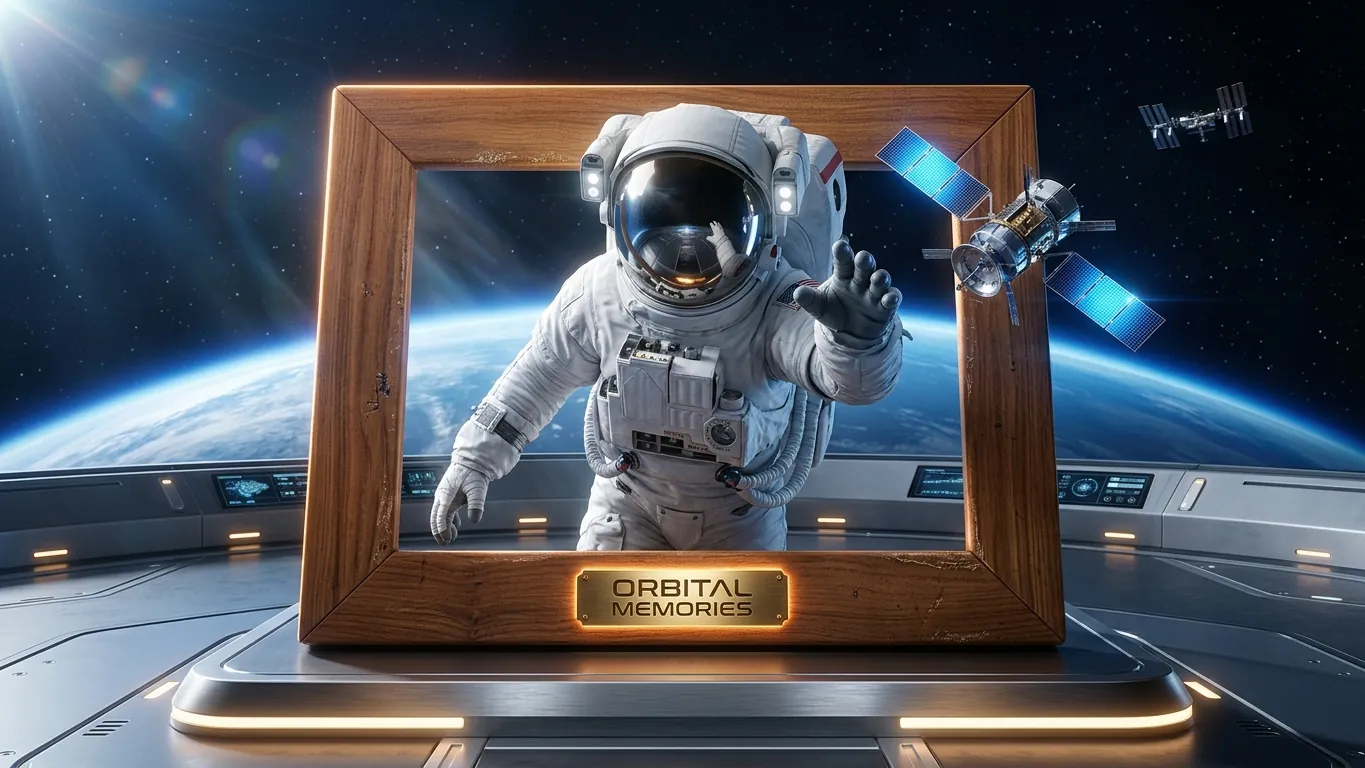
Orbital Memories is a browser experience set 408 km above Earth. You sit in a spacecraft cockpit beside the pilot, look around the cabin and steer while Earth drifts past the windows. Then you open the hatch and float outside on a spacewalk, near a space station and a satellite, as radio calls from mission control come through.
It is built for VR, runs on WebXR and was tested on a Meta Quest 3: open the page in the Meta Quest Browser and press Enter VR, with no app to install. In VR you sit inside the cockpit as the cabin moves with you and Earth turns past the windows, then press the trigger to fade outside and float behind your astronaut on the spacewalk. The left stick steers or moves, the right stick rises or sinks, A/X switches between the cockpit and the spacewalk, and B/Y changes the orbit speed. It is designed to be enjoyed seated. On a laptop or desktop, it runs in any modern browser.
Very few people will ever see Earth from orbit. This is for the ones who never will: a parent who can't travel, a friend who lives far away, a child who dreams of space. The gift is a postcard. Take a photo with your webcam or upload one, and your face appears inside an astronaut's visor with Earth behind you. Add a message in your own words, choose a walnut or titanium frame, then download or share it. The postcard can also be exported in 3D: as a GLB model, a side-by-side stereo image or a red/cyan anaglyph. The GLB is designed for the Jupiter SR glasses-free 3D display, with the astronaut, the frame and Earth as real depth layers rather than a flat image.
Tripo generated the spacewalking astronaut, the two seated pilots, the spacecraft, the satellite and the wooden frame. World Labs Marble created the cockpit panorama, PixVerse made the cabin-to-spacewalk transition from frames of the app, and the Earth imagery comes from NASA Blue Marble. Three.js handles the real-time 3D and WebXR.
How Tripo was used
Tripo generated the main models of this trip to orbit, and they go straight into the Three.js WebGL pipeline.
- Characters: the spacewalking astronaut in an EMU suit, and the two pilots seated in the cockpit.
- Spacecraft and satellite: the craft you ride in, and the SAT-04 satellite you float near on the spacewalk.
- Postcard frame: the chassis of the 3D wooden photo frame.
- The astronaut on your postcard: your face is mapped onto its visor live, and its +Z coordinates are calibrated for the Jupiter SR display so the astronaut and the solar panels break out of the frame into positive parallax.