 View in store
Description
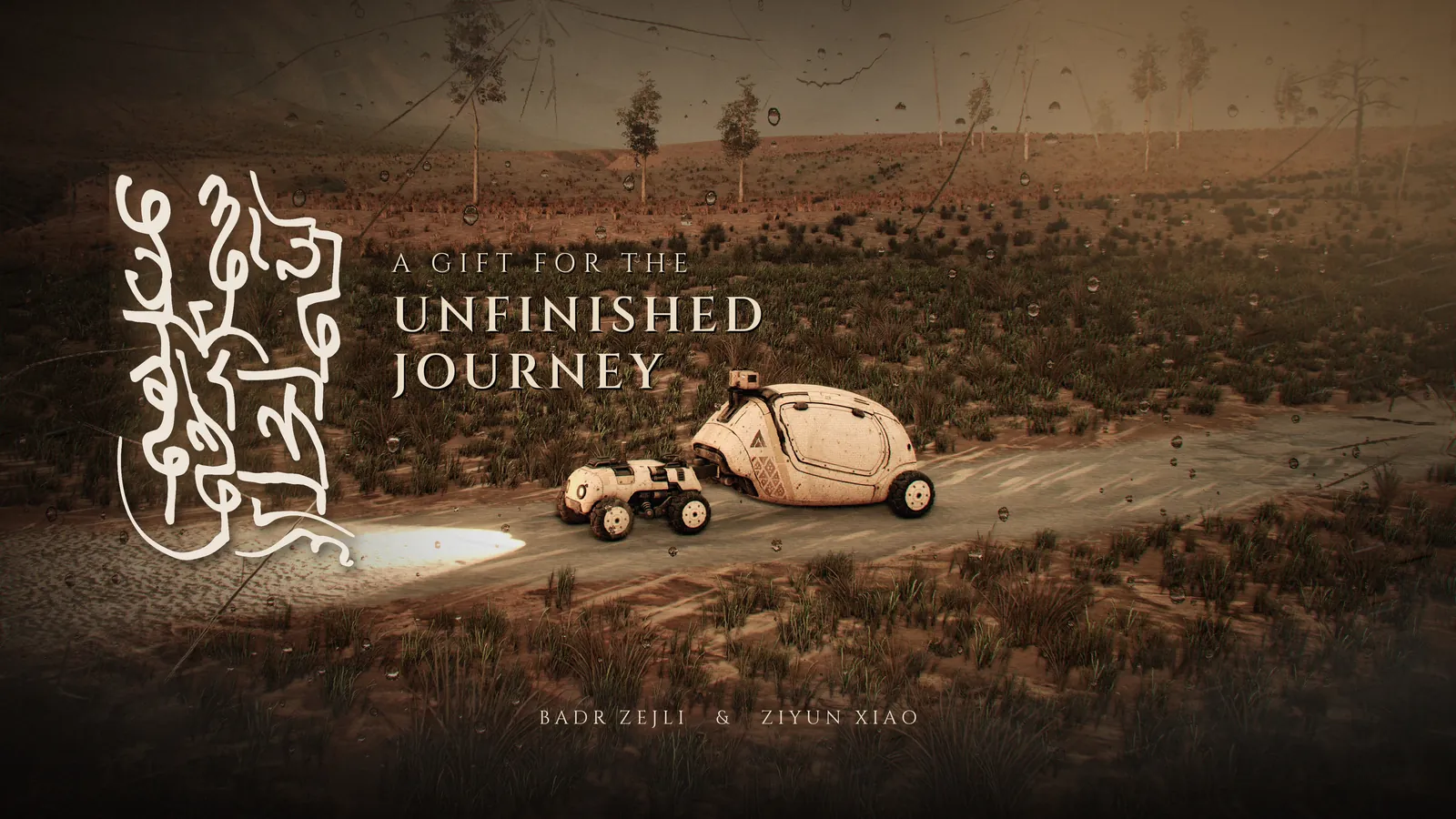
A Gift for the Unfinished Journey is a narrative adventure game dedicated to the unfinished journey. You are Carrier 07, a walking machine in an emptied highland valley, towing a sealed archive up a 5 km mountain road to Âlaawb, the last transmitter.
Along the way you receive radio signals playing back an unknown past. Some of it is spoken in Saskartan, a language made for the game. Nobody else is on the road. Only wind, a Geiger counter, and the voices.
The game was made in Unreal Engine 5.8 on Gaea terrain. World Labs Marble generated three explorable splat worlds; the team's own converter turned the Gaussian splats into Unreal meshes, draped them onto the Gaea terrain and streamed them with World Partition. A custom material bakes the music's loudness, bass and onsets into a texture, so every splat drifts in time with the sound, with dithered opacity and a distance fade. Voices come from the team's own recordings as well as ElevenLabs and edge-tts, and editor automation runs through Hayba, the team's own MCP tool.
Saskartan and Hayba both existed before the hackathon. All the writing in the Saskartan script, the translations of the English lines and everything else apart from third-party assets were made during the event. The game is available for Windows.
How Tripo was used
Tripo built most of this world: more than 40 generated assets, plus the traveler character.
- World assets: ruined arches, mudbrick villages, a downed airship, the radio station and the summit relay tower were all generated with Tripo.
- Beyond static props: the traveler was rigged, animated and resampled into a Niagara point cloud for the loading screen.
- One pipeline: Tripo generation, Blender cleanup scripts, automated Nanite import into Unreal, then placement with PCG and the team's own set-dressing tools.