 Download source
Description
The World Comes to You is a miniature Earth and the true-scale universe around it, made for anyone who holds the whole world in their heart but is stuck where they are. The gift isn't about traveling; it brings faraway places to where you can reach: if you can't go, the world comes to you. It acknowledges your situation first, then hands you a way out, and the way out is this world itself.
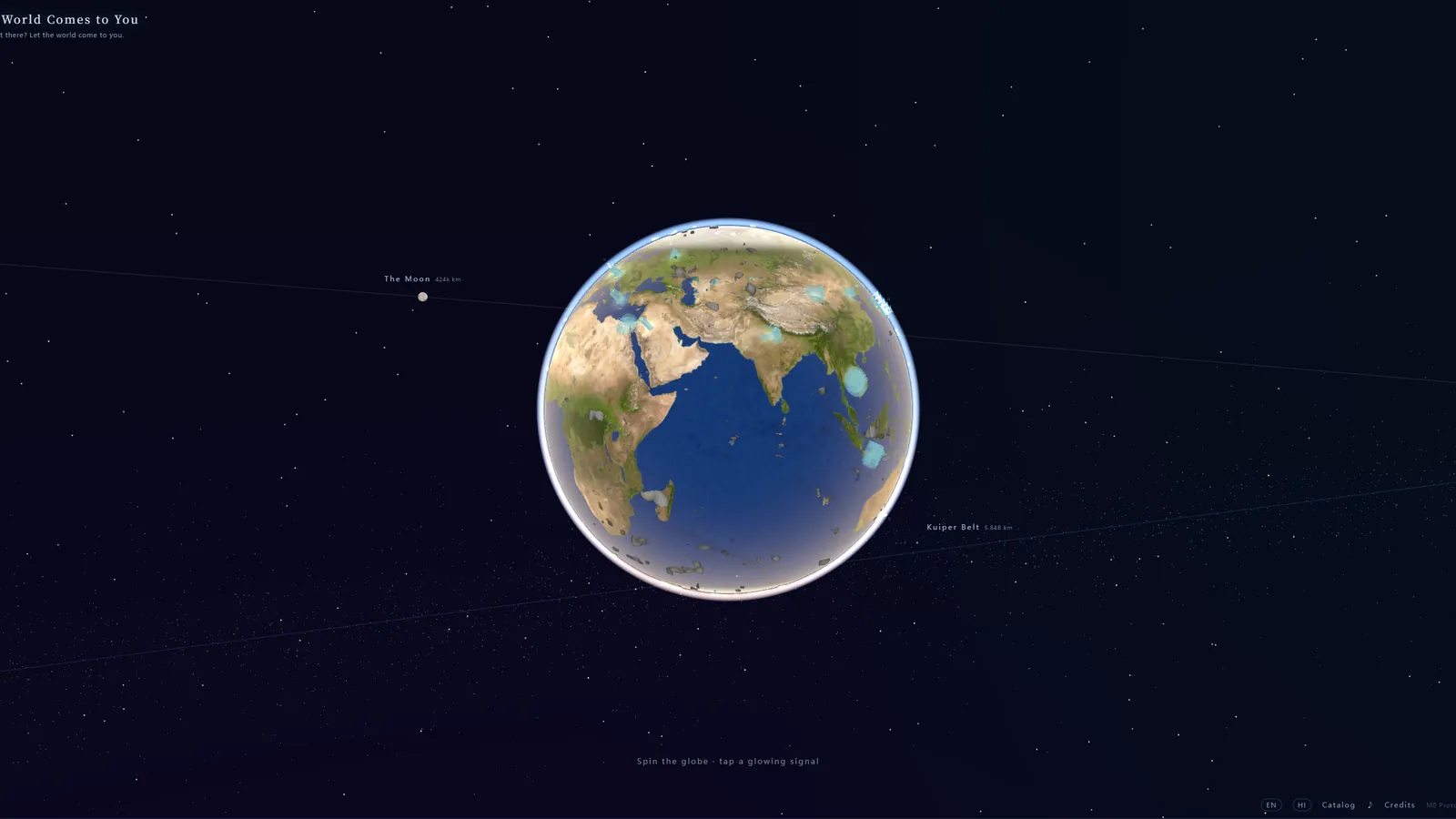
The game opens with a letter. As the camera pushes in, Earth becomes the hub: real day-and-night textures rotate slowly, with a golden terminator line, volumetric clouds, a glowing limb and auroras on the night side, while 19 landmark signals pulse cyan across the globe. Pull back and you are in a true-scale solar system measured in Earth radii (6,371 km): the Moon sits at 60.3, one astronomical unit is 23,481 and Neptune lies at 706,524, with orbital periods scaled from real days so that one year equals 12 day-night cycles. You can visit the Sun and all eight planets, see real lunar phases and Saturn's rings, and snap a postcard for your cosmic album.
Two of the 19 signals can be entered on foot. One is a hidden stone realm in the first cave level, where three boundary stones stand for door, path and light. The other is the Pyramids of Giza, a walkable Gaussian-splat world made with World Labs Marble image-to-3D, holding three treasures: a golden scarab, the Rosetta Stone and a canopic jar. The other 17 stops are visit cards: read a letter, then light it up on your return trip. Tap a signal and the camera dives, a white flash, and the splat world fades in while the loading text reads "Syncing signal…", turning the wait into part of the world.
The pacing works on three levels: 30-to-60-second loops of collecting items and getting appraisal cards with a name, a fun fact, a rarity and an "AI generation recipe"; 3-to-5-minute worlds with three treasures, the last one slightly hidden; and a long arc of raising a pillar of light, revealing a stamp, watching the miniature landmark grow onto your globe after the return trip, and unlocking the next stop until all 19 are lit. There is pressure, too: your heart lamp has three segments, and the dimmer it gets, the smaller the lit area and the world become; lava, falling rocks, quicksand and sandstorms make you crouch, detour, time your moves or hide in pools of light. But no failure, no timer and no combat are fixed rules: when the lamp goes out you are stunned for 0.8 seconds and pushed back to the nearest light, with no progress lost.
The ending is warm: a collection book, badges, a stamp passport, a share card that reads "I didn't get to see the world, but I lit up N civilizations first," postcards for your cosmic album and Saturn at opposition. One background track plays throughout, the camera never shakes, and taking a hit only tints the screen edges dark red. The worlds were generated with World Labs Marble and the models with Tripo, with AI reference images keeping the art style consistent; other AI tools used include Seedream and Rodin Gen-2.5. The game is in Chinese and English, offers three graphics tiers on mobile and has a desktop version. It is provided as source code and needs to be built and run yourself; the stack is Vite, Three.js and Spark.
How Tripo was used
All 37 of the game's 3D models were generated with Tripo. World Labs builds the atmosphere of each scene, while Tripo supplies the close-up and interactive props; together they make up the levels.
- 19 miniature landmarks for the globe, which grow onto your Earth after each return trip.
- 3 pyramid treasures: the golden scarab, the Rosetta Stone and the canopic jar.
- 11 cave pieces and 4 pyramid ornaments.
- How they were made: generation settings were tuned to the game's needs (for example, no textures or a 15,000-face cap), textures were downscaled from 4K to 2K locally, and a batch orchestrator handled rate limits and downloads automatically.