 Download source
Description
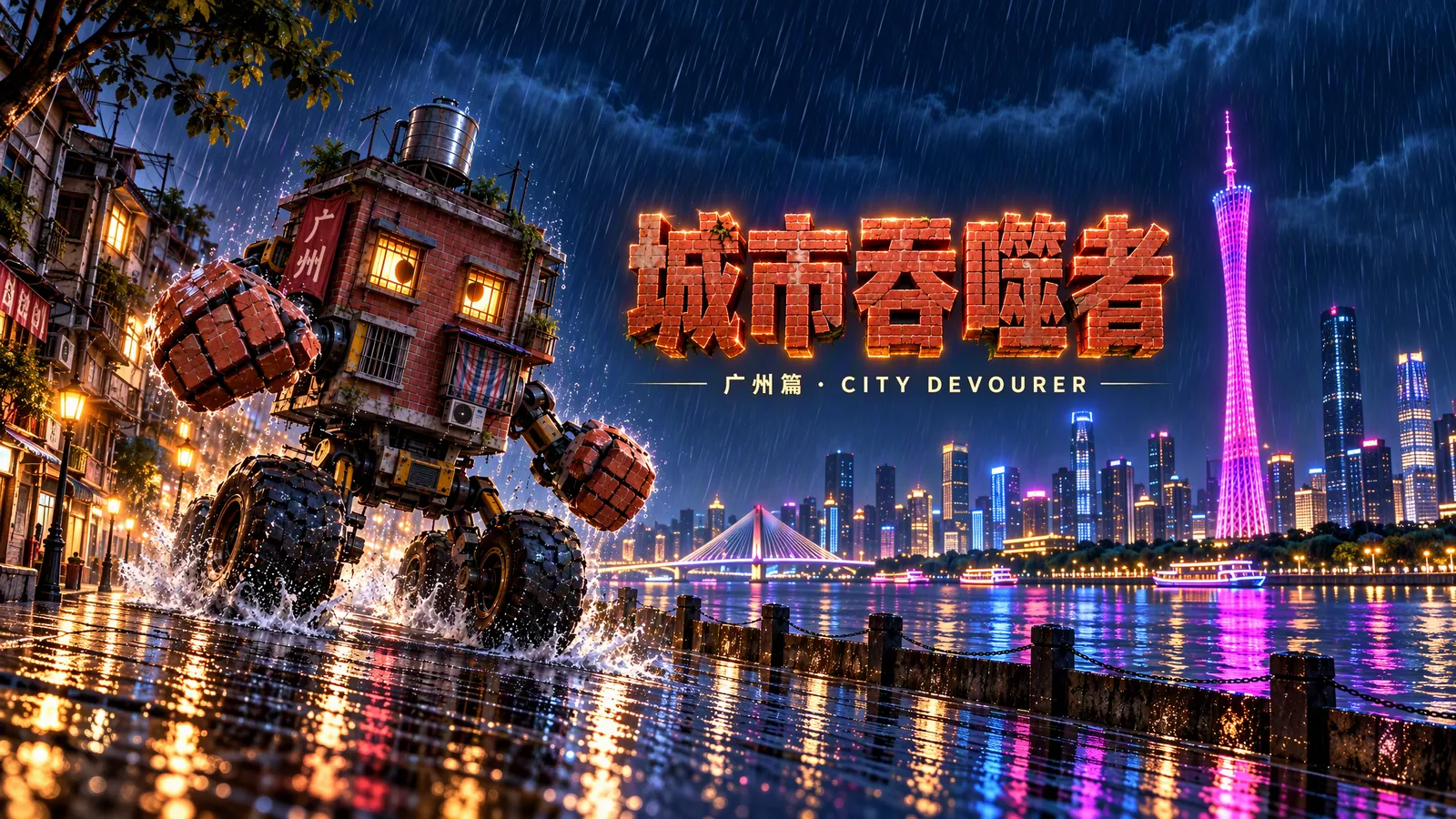
City Devourer: Guangzhou is a 3D action game for PC. You play a little brick house that wakes up in Guangzhou's Liede Village: it sprouts four wheels and a pair of brick fists and heads north through a rainy night, past the narrow alleys of the urban villages, the Pearl River embankment, the residential towers of Tianhe and the glass forest of the CBD, until it reaches the foot of Canton Tower. The buildings along the way are waking up too: village houses charge at you behind door panels, apartment blocks fling flowerpots and air-conditioner units off their balconies, mixed-use towers slam down rolling shutters to ram you, and office towers bounce your shots back off their glass curtain walls.
This world has one rule: no building falls for nothing. Every building you knock down breaks into rubble, and the little house lifts the rubble and swallows it, growing from a one-story brick house into a brick-hammer building, then a mechanical-arm building, and finally a walking, living tower. The color of the bricks you eat decides what you become: arcade-building tiles, Pearl River water, neon-sign electricity and construction-site rebar each bring their own fighting style. Now and then the rubble drops a memory piece, such as the rain-polished plaque from Liede Village's memorial archway, or a five-mao ferry ticket from Haizhu to Tianhe.
Left-click to punch (tap for a basic attack, hold to charge), press Space to dash, Q to pick up rubble, then Q again to devour it or left-click to throw it. With each growth stage your body and moves change together, and every type of enemy calls for a different approach. After clearing a block, you pick two of three rewards, Heart of the City, Red Brick Core and Lights of a Thousand Homes, with R: a new card, a star upgrade for a card, or a bit of health. Four faction statuses, Shatter, Soak, Shock and Pin, combine in pairs into combo effects such as Short Circuit and Weld. Liede Bridge and Canton Tower, the two most fully awakened landmarks, are the two boss fights.
This gift is first of all for Guangzhou. Urban villages, arcade buildings, herbal tea shops and old ferry piers are being torn down and renovated one after another. The team cannot make them stay, but in the game they can let them wake up once: every building fights back and falls in its own way, and is remembered by a little house. It is also for everyone who started out in a small rented room in an urban village and slowly grew up in the city. After Canton Tower is defeated, the final screen reads: "Canton Tower lights up again with the lights that belong to this city."
The team began by writing a single game-direction document as the one spec, then iterated in rounds: after each round, a real person played a full run and exported the game's built-in playtest log, which was split into tasks for the next round. Claude Code wrote the code issue by issue, and Playwright auto-plays 55 scenarios inside the running game. Built on Three.js, the hero, the enemies and the whole city are generated procedurally in code, the music and rain are synthesized in real time with Web Audio, and the team packaged the game with Electron for Windows and macOS, with no internet connection needed. It is provided as source code and needs to be built locally.
How Tripo was used
Tripo handles the ornate carvings and organic shapes that are hard to build in code, an important addition to both visuals and gameplay: the hero, the enemies and the city are all generated procedurally, and 12 models generated with Tripo P2.0 fill in the details.
- 12 models: the three clearing rewards, Heart of the City, Red Brick Core and Lights of a Thousand Homes; the lime-plaster roof ridge and pair of stone lions on the Liede Village archway; a dragon-boat head and a kapok tree on the Pearl River embankment; the buses, taxis and trucks flung by Liede Bridge; and the observation-deck rings hurled by Canton Tower along with the Haixinsha tents at its base.
- Each has a gameplay job: vehicles and rings are boss attacks, kapok trees and tents are cover that can be knocked down or smashed, the dragon head is a big piece of rubble you can devour or throw, and the rewards glow in faction colors.
- No manual web work: Claude Code picks out irregular objects without moving parts, GPT Image 2.5 draws reference images in the game's art style, Tripo CLI turns them into models with image-to-3D, and Claude Code checks the previews and in-game screenshots to judge the quality.
- Into the game: textures are compressed so each model comes to about 0.7 MB, reference images and task IDs are logged, and a shared loader normalizes the size before attaching the models to the code-built archway, bridge and tower. If a model fails to load, the game falls back to the procedural version, and every model is covered by an automated playtest.
These 12 models cover rewards picked up more than ten times a run and the attacks in both boss fights, giving rainy Guangzhou its instantly recognizable lime-plaster sculpture, kapok trees and dragon boats.