Author: Jared Liu
 Try it live
About this project
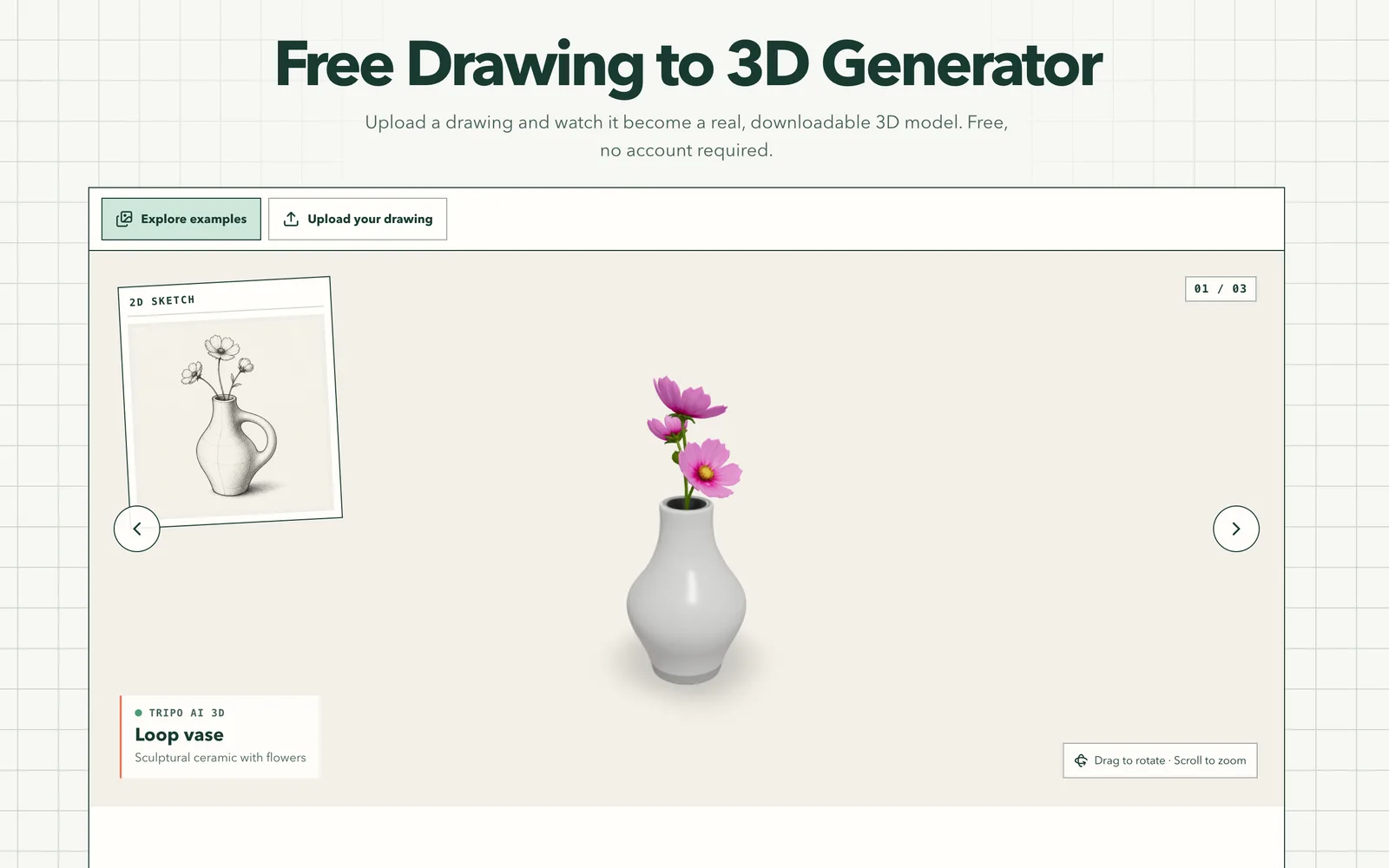
Drawing to 3D turns “how does a sketch become a 3D model” into something you can play with on the spot: the three homepage examples — a vase, a robot and a mushroom cottage — were all generated from real hand-drawn sketches with Tripo image-to-model, shown side by side with the originals, ready to drag, orbit and zoom.
Upload your own drawing, pass the human check and the anonymous queue takes over: a reconstruction animation plays while you wait, then the white model spins in the browser and downloads as GLB. For 8K textures and higher fidelity, one click carries the result into Tripo Studio. The whole site needs no account, speaks six languages, deploys as static files — and keeps Tripo credentials sealed inside a Worker.
Highlights
- Three examples — a vase, a robot and a mushroom cottage — all generated by Tripo from real hand-drawn sketches, shown beside the originals, ready to drag and orbit
- Upload one drawing (PNG/JPG/WebP), pass the human check and the anonymous generation queue takes over — no sign-up
- A sketch-to-volume reconstruction animation plays while you wait; the finished white model spins in the browser and downloads as GLB
- One free generation per device per day; for 8K textures and higher fidelity, carry the result into Tripo Studio in one click
Technical breakdown
Example delivery · Tripo v3 image-to-model
All three example models come straight from Tripo API v3 image-to-model (v3.1) with detailed geometry, PBR textures and a 50,000-face cap; the repo keeps each task ID, credit cost and output SHA-256 as delivery provenance. The web copies preserve the H-series geometry and only drop embedded textures from 4096px to 2048px — no visible change in the ~500px viewer, and about 75% less texture VRAM.
Anonymous generation · a no-account white-model pipeline
The browser holds only public configuration; Tripo credentials live exclusively in a Cloudflare Worker dispatcher. Turnstile plus a device fingerprint buy one anonymous generation per device per UTC day: create the job, upload the drawing, poll every 4 seconds (exponential backoff to 30s on repeated failures), then download the GLB blob and render the white model in place. Closing the page abandons the job via sendBeacon, with the scheduler lease as the cleanup fallback.
Waiting as theater · clipping-plane reconstruction
No spinners during generation: the model carries two materials — a solid one revealed bottom-up by a horizontal clipping plane while a wireframe hides top-down in reverse, with an orange scan ring tracking the plane — literally acting out “AI rebuilding volume from lines”. A perceived-progress bar eases through status-mapped ranges, and prefers-reduced-motion users get a still pose.
SEO-first · a six-locale static site
Next.js 16 builds to fully static output; English, Traditional Chinese, Japanese, Korean, Spanish and Portuguese each get their own routes, canonicals, hreflang alternates and sitemap entries. Every Tripo Studio link is produced by one shared module with consistent UTM attribution — utm_content pins down the exact CTA or selected example.