 Try it live
Description
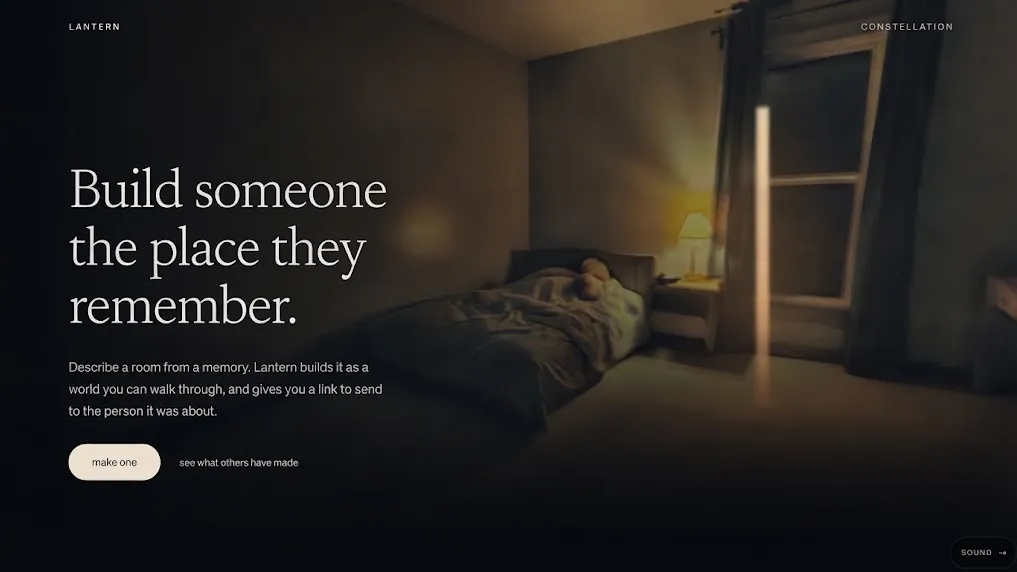
Lantern turns a memory into a place you can walk into, and gives you a link to send to the person it is about. You don't describe a scene. You describe a room someone actually remembers: "Her kitchen in Lagos, always too hot, always smelling of fried plantain."
Lantern builds it. World Labs' Marble generates the room itself as a Gaussian-splat world you walk through in first person. Tripo generates the specific things that mattered in it, like the blackened frying pan, the enamel bowl and the kerosene stove. They are composited into the splat scene with correct depth occlusion, so they sit behind and in front of the real geometry instead of floating on top of it. Marble makes the place, Tripo makes the things in it, and the gift is the two together. You can also record your own voice onto any object: when they walk toward it, you fade in.
Lantern is built for the person who opens the link, not the person who makes it. The recipient gets a door with their name on it, the memory in your words, and one button: step inside. No account, no app, no instructions; everything they need is in the link. Every world is a gift for exactly one named person, about a place the two of you shared, and the constellation gallery holds the ones people chose to share. It all runs in the browser, even on a phone: describe, build, send, open.
Two days before kickoff, the author did only the pre-event spike the rules allow: a project scaffold and proof that the World Labs and Tripo APIs worked. The gift concept and recipient flow, a generation pipeline that finishes a gift even if the sender closes the tab, hybrid rendering that depth-composites Tripo meshes into Marble splats, first-person movement with collision, object placement, spatial voice notes and the landing page were all built during the event.
How Tripo was used
Tripo makes the things inside each memory.
- Text-to-3D: DeepSeek turns the sender's words into 3–6 object prompts (the blackened frying pan, the enamel bowl, the kerosene stove), and Tripo builds each one as a low-poly textured GLB.
- In the world, not on a turntable: each mesh sits inside a Marble splat world, depth-composited so it occludes and is occluded by the real geometry. The browser raycasts Marble's collider to find a surface and rests the object there.
- Lighter files: turning PBR off and capping faces at 10k cut one model from 3.46 MB to 708 KB.