Author: kevin
 Try it live
About this project
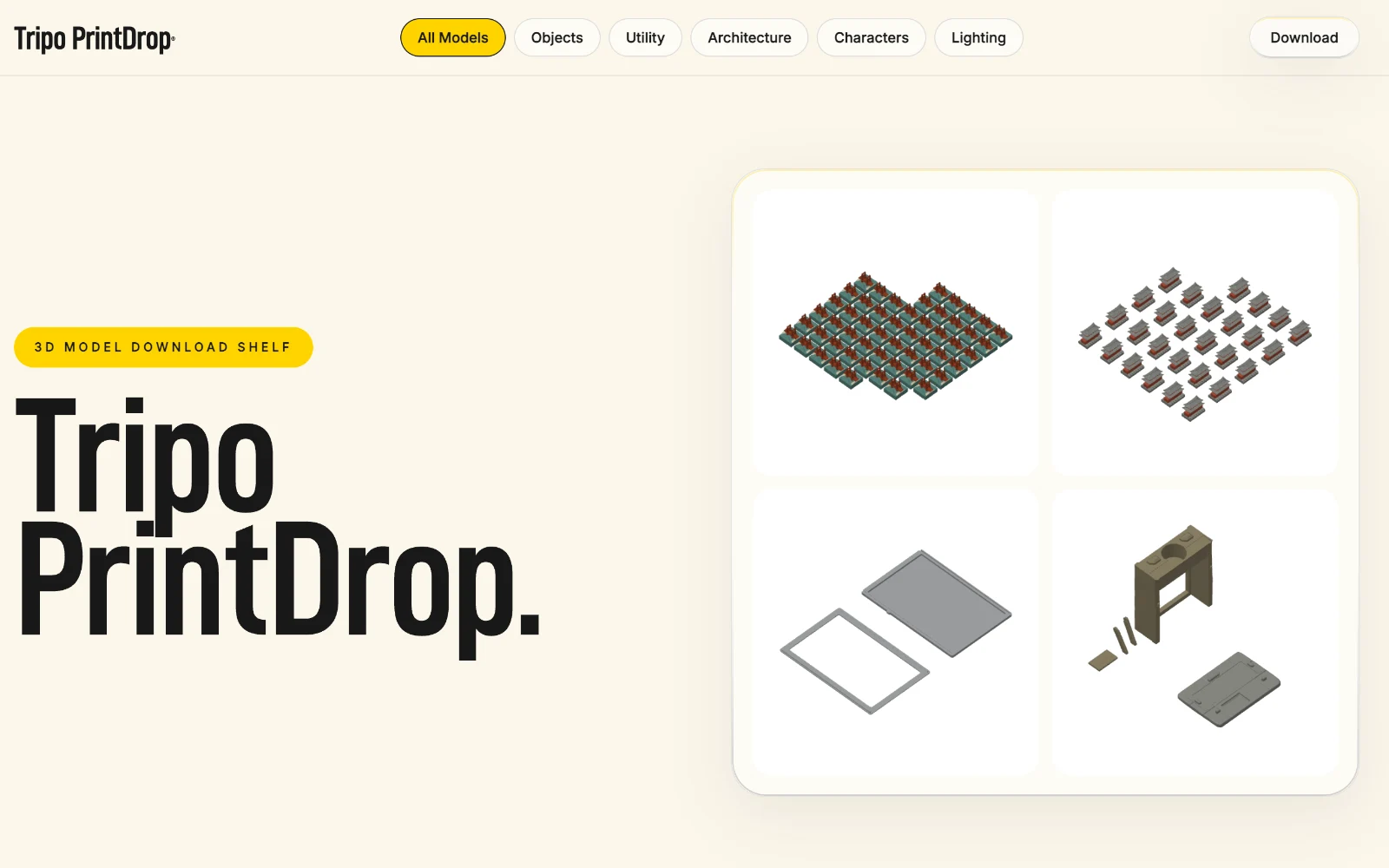
PrintDrop is a print-ready model shelf: 60+ models generated with Tripo and processed into printable 3MF / STL files, spanning objects, utility parts, architecture, characters and lighting — from hot-shoe covers and card sleeves to a triceratops-skull lamp.
Every model card embeds a real-time Three.js preview so you can read the structure and volume before downloading; files are served as direct links, ready to drop into slicers like Bambu Studio — a complete pipeline from AI generation to physical print.
Highlights
- Every model card embeds a live Three.js preview — read the structure and volume before downloading
- Browse five categories fast: objects, utility parts, architecture, characters and lighting
- Files ship as direct 3MF / STL links, ready to drop into slicers like Bambu Studio
Technical breakdown
Batch delivery · Tripo output → print formats
All 60-plus models on the shelf come from Tripo, then get converted into the formats the print pipeline needs: GLB stays for the web preview, while 3MF and STL go straight into the slicer. Between AI generation and the printer starting up, format conversion is the step that matters most — preview files keep the good-looking PBR finish, print files keep the geometry true.
In-card previews · a three-format ModelViewer
Every model card embeds a self-built ModelViewer with three loaders mounted side by side — GLTFLoader, ThreeMFLoader and STLLoader — so all three formats spin right inside the card. The camera frames itself from each model’s bounding box, and OrbitControls lets you orbit freely — more than 60 models, one shared viewer, and that’s plenty.
Thin backend · Supabase
The site itself is fully static (React 19 + TypeScript + Tailwind); model metadata and file downloads are handed to Supabase — a zero-maintenance database plus direct object-storage links. The whole project doesn’t own a single server: once deployed, it’s live.